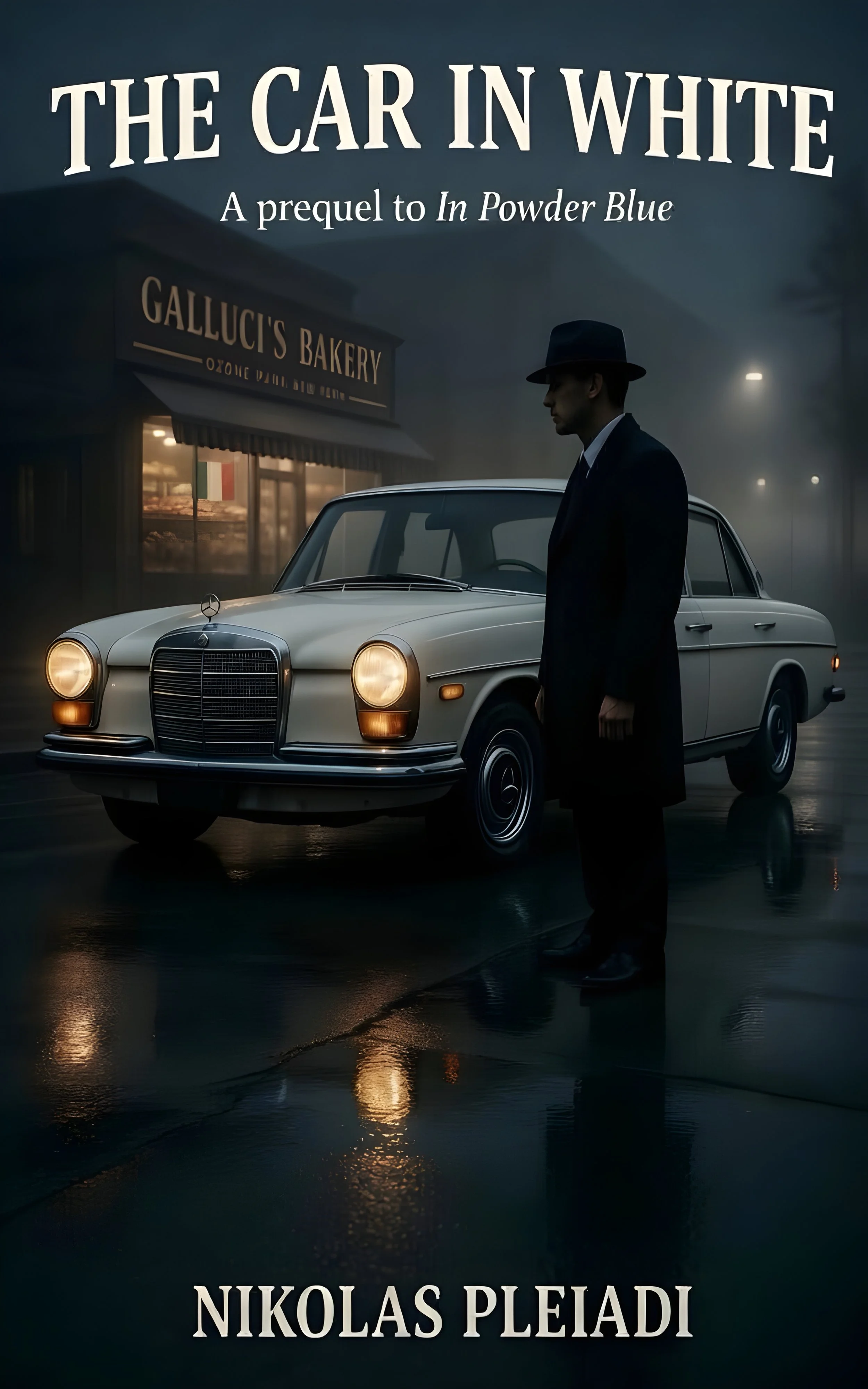
The Car In White
A Prequel to In Powder Blue
Sixteen-year-old Salvatore LoCicero works the floors and does minor repairs, learning the trade at Vito’s auto shop in Queens, keeping his head down and staying out of trouble. But one night, a brutal encounter with a pair of child predators rips through the small world he knows, leaving marks on his soul that will never fade.
Out on the island, Anthony “The Midget” Ombrosi loses his mother in a violent crash on the Long Island Expressway. The tragedy hardens him, sharpening a hunger and ruthlessness that will shape every choice he makes. Alongside his childhood friend Joe DiPalma and their new partner Jimmy Hunter, Anthony begins building a cocaine empire, pushing Joe further to the margins as the streets of Queens and Long Island bend to their ambition.
When Sal crosses paths with Maria DiPalma, sparks fly, and a love story blooms amid the chaos. They marry, but the world Sal thought he’d left behind keeps pulling him back—into a life of loyalty, danger, and survival where one wrong step can cost everything.
Spanning the 1970s through September 11, 2001, The Car in White is a raw, cinematic prequel to In Powder Blue, tracing the choices, betrayals, and bloodlines that set the stage for Vincent LoCicero’s world.
For fans of Goodfellas, The Sopranos, and Mystic River, this is where the saga begins.
It’s me, Vinny.
Or I was.
Hard to tell what counts as living once the story catches up to you. Maybe I’m still walking around. Maybe I’m just what’s left over after the party ends.
I know how I got this way.
My father—Sal, though. He moved through life like something was always trailing him. He kept his hands clean, far as I ever saw, but that doesn’t mean they never touched the fire.
And Joe—you know how he ended up.
But do you know where that road started?
I was twelve when my mother died.
September 11th
That day didn’t just break the world around me—it split me in half too. I spent years trying to fit the pieces back and every one of them cut. That was the beginning for me, but the fuse was lit long before I knew I was standing on it.
Then came the dope.
The lives thrown away.
That fucking USB.
Maybe I’m talking from a porch somewhere.
Maybe from that beach.
Or from the depths of the black tide itself.
Maybe I’m in a place you can’t stand on—
but still remember.
Maybe I’m alive. Maybe I’m not.
Maybe I’m something in between—
memory with a pulse that comes and goes.
The streets still speak. The past doesn’t disappear.
It waits in the dark, quiet as death, until someone says your name.
It always waits.
And now—if you listen close enough—you’ll hear it whisper everything I’ve carried.
Everything they left behind.
Everything I became.
Chapter 1
December 7th, 1970- Far Rockaway, New York
Salvatore LoCicero never forgot the way his father came home that early morning. It was dark and cold. The wind off the bay had a way of getting in your teeth. When he walked in through the door in his turnout gear, Valley Stream Fire Department patch on the sleeve, boots muddy, coat half-unzipped—he looked like he hadn’t even bothered to stop moving since the call. He didn’t speak or even bother to take off his jacket. He just stood there under the kitchen light with smoke still clinging to his skin.
He wasn’t from the Levittown station, but when the call came over the Valley Stream channel and he realized how close he was, he didn’t wait. He knew that stretch of road—dark, fast, no guardrail—and by the time the local trucks rolled up, he was already kneeling in broken glass.
Sal was sixteen. He had just woken up and was sitting at the table flipping through the sports section of the Post. “You alright?” he asked.
His father leaned against the counter. “There was a crash—out on the L.I.E.. Drunk driver. Head-on. She was nine months pregnant. The car flipped three times, landed in a ditch. They tried to get the baby out.”
Sal stopped chewing.
“Didn’t make it,” his father said. “Neither did she.” He finally sat, slowly, like the chair might break beneath him. “There was a kid on the call,” he added. “Young cadet. He rode in with her. Did CPR. Bagged her the whole way to Mid-Island. Didn’t say a word.”
Sal didn’t either.
“It was his mother.”
“What’s his name? Maybe I know him.”
“I doubt it. Kid from Levittown—Anthony Ombrosi.”
It meant nothing to Sal then. Just a kid. Just another story from the job. But the look on his father’s face was different that night.
Years later, when that name came back around—different place, different meaning—Sal would remember the smell on his father’s coat when he walked in. He’d remember the way it all started.
Even if he didn’t see it yet.
The Night Before- Levittown, New York
The joint was Thai stick—thick, sticky, rolled tight with thread and leaf. It burned slow and tasted like incense and cat piss—the best they could get back then.
Joseph DiPalma held it up like it was a gold bar. “I’m telling you, this is Vietnam-grade.”
Anthony Ombrosi took a hit and exhaled into the cold. “You’ve never been to Vietnam.”
“My cousin has,” Joe said, eyes half-shut. “Brought some back.”
They were sitting on cracked lawn chairs behind Anthony’s house in Levittown,
bundled in coats, hoods up, boots scuffed from salt and snowmelt. The yard was half-dead grass and rusted patio furniture. The sky was low—grey-orange from streetlight haze. You could hear the buzz of a transformer down the block.
Joe tapped ash into an empty Pabst can. “You think Mr. Delvecchio back in the neighborhood really killed that guy?”
“He’s got the eyes for it,” Anthony said.
“Eyes?”
“Yeah. Dead eyes.”
“I heard it was over some whore.”
“You hear a lot of things.”
“Your mom working?”
“Yeah. Double at Mid-Island.”
“Goddamn. She never stops.”
Inside the house, the Plectron Receiver buzzed. Both boys turned at once. A red light blinked through the kitchen glass.
Anthony stood, walked in and heard the call.
“MVA—Eastbound L.I.E.
Head-on collision.
Overturned vehicle.
Pregnant female—entrapment”
Joe sat up straighter. “That’s a real one.”
Anthony grabbed his jacket—navy blue, LEVITTOWN FD stitched on the back—and started pulling it on.
“You want me to come?” Joe asked.
Anthony was already moving toward his bike. “Nah. Head home.”
“You sure?”
“Yeah.”
Joe stuffed his hands into his pockets and walked toward Hempstead Turnpike to catch the N6 bus. He’d transfer at Jamaica and take the 7 back to Corona. Less often, he’d drive his silver 1965 Chevy Nova—back to the apartment two floors above the deli his grandparents owned, they were straight off the boat from Sicily and lived downstairs.
He didn’t know it yet, but that was the last time he’d see Anthony the same way. As Joe walked to the bus stop, collar pulled up against the wind, he thought back to when he and Anthony first met.
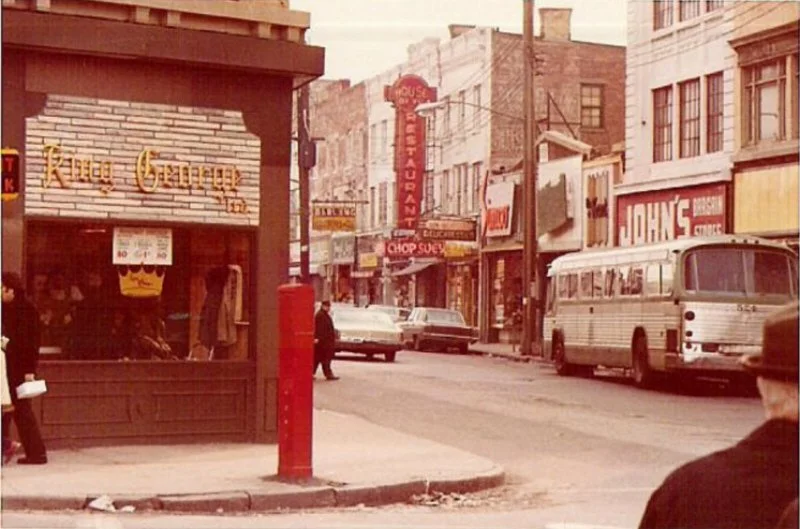
They were kids then—Corona street urchins. Running around the cracked sidewalks off 108th Street, playing stickball behind Our Lady of Sorrows Catholic School, where they attended.
Anthony had moved in with his parents when he was five, into a ground-floor apartment across from a junkyard. He had always been short for his age, but what he lacked in height he made up for in presence.
When he was a little kid, he looked like a bulldog—short, square, stubborn and
already daring anyone to push him. They met when Joe beaned him with a pink Spalding
during a disputed double-play. They fought. Then shared a slice at Mario’s and were tight ever since.
Above the deli, the walls were thin, the air thick with grease, the toilet never flushed right—but it was home.
Anthony’s place was quieter. His mother was sweet, always offered juice or cookies. His father didn’t talk much, half his face always hidden behind a newspaper or a radio repair kit. Then, just before they turned ten, Anthony’s old man got a job out on the Island—Grumman, some defense contract gig—steady union work.
A Levitt house came with it.
With a yard.
And a driveway.
And a tree.
The day they moved, Joe helped him pack his baseball cards and a box of comics. They didn’t talk about it like it was goodbye. Just a thing that was happening. After that, they rode the trains to see each other—LIRR, The 7. Sometimes Anthony would come in for the weekend. Sometimes Joe would sneak out to Levittown for a couple nights, claiming he was staying with a cousin. They drifted between worlds—city grit and suburban lawns—like kids caught in a crack between timelines.
At thirteen, they started taking the train down to Union Square and buying weed from the Jamaican guys who sold it rolled in magazine paper behind the subway stairwells. Nobody questioned two skinny city kids if they moved fast. They’d cop nickel bags and flip them back on the Island for twice the price. Anthony knew the crowds to hit.
Joe handled the muscle.
Anthony handled the weight.
They met Jimmy Hunter on the train one night. He was loud and wild—bouncing between cars. Preppy Hair-do, preppy clothes—but he had busted knuckles and a wild glint in his eye.
“Yo, that Thai?” he asked, pointing at their joint like they were old friends.
Turned out his parents had money—real money. His father was a surgeon. He lived in Manhasset, big house on a hill—country club type. But Jimmy had no interest in golf or prep school. He liked fights, drugs and chaos. By the end of that ride, he was
laughing with Joe and trading numbers with Anthony.
Within a week, he was buying in bulk.
Within a month, he was helping move it west.
Jimmy knew the rich kids. The ones who didn’t want to be seen copping on street corners. The ones who paid double to have it passed through a party, gym bag or open locker.
He was crazy and unpredictable, but he opened doors.
And now, walking toward the bus stop, snow crust under his boots, Joe didn’t
know what Anthony was riding into. But he knew the air felt different—like
something was already gone.
Corona, Queens
The lights were still on in the deli when Joe DiPalma hit the corner of 108th. Inside, the whole family was in motion. Giuseppe DiPalma, Forty-Two, thick around the shoulders, was out front spraying down the sidewalk with a hose. Serafina, his wife, Thirty-Nine, fast-handed and faster-tongued, sat on a stool counting register money with one hand and swatting flies with the other. Maria, thirteen, was boxing up rolls behind the counter like she was packing ammunition.
And on the floor, under the counter near the scale, sat the youngest—Douggy, eight—knees bent, eyes locked on a toy police cruiser he was rolling slowly back and forth on the tile. Focused. Serious—like he was already in the academy.
Joe stepped through the door just in time to get beaned in the chest by dinner roll.
It was Maria.
Joe didn’t see who threw it. “Christ Almighty. I leave for four hours and we turn into the goddamn Three Stooges?”
“Language!” Serafina barked without turning.
“It’s a bread roll, Ma. Not the body of Christ.”
Maria snorted.
Giuseppe kept hosing the sidewalk like he hadn’t heard.
Douggy didn’t look up—he was too busy steering the cop car around invisible corners, making soft whoop-whoop sounds under his breath.
Joe moved around him. “Douggy, one more lap with that fuckin’ cruiser and I’m tellin’ Sister Colletta you touched your pishy in front of Saint Mary.”
“Joey!” Maria gasped, nearly choking on laughter.
From the second-floor hallway near the stairs, Nonna Paulina, Giuseppe’s mother, eighty-four—always in black, shouted up in her gravelly voice. “Joseph! Braciole’s done! Wash your hands! You smell like sin!”
“Nonna,” Joe hollered back, “I’m sixteen! What do you want me to smell like—a priest’s fingers?”
Maria slid off the stool laughing so hard she couldn’t breathe. Even Serafina turned red trying to hold it back.
In the hallway, Vincenzo, eighty-six, Giuseppe’s father and the old lion of the house, stood near the coat rack with a Toscano cigar clamped between his teeth. He took a slow drag and mumbled to no one in particular: “Anche se il gatto si traveste da sacco di farina, è sempre un gatto.”
Even if the cat dresses like a sack of flour, it's still a cat.
Three generations. One table.
The world still whole.
For now.
Outside, the gate slammed shut. The last customer walked off into the dark. And somewhere east—headlights veered left.
Westbound L.I.E.- Near Exit 42
By the time Anthony got there, the sirens had mostly gone quiet. Only the slow churn of diesel and radio static over wind. The car was upside down in the ditch just past Bethpage, half in the shoulder, half sunk into cold mud. The front end was flattened. He moved on instinct. He didn’t say anything to any of the other guys. He just joined the others working the rear.
“Passenger side’s crunched in. Gotta go through the back,” someone said.
They popped the hatch. That’s when he saw her—skin gone grey, wedding band still on, belly round, taut under the torn seatbelt. Something inside Anthony locked up. Then he stepped forward anyway. He helped slide her out, braced her spine and laid her on the board.
“Got a pulse!”
The medic started compressions. Anthony took the bag valve and sealed it over her face. He pumped steadily. No one asked anything. No one looked twice. He kept pumping in the back of the ambulance.
He didn’t stop until the ER doors opened.
They took her inside.
Bright lights.
Clipped orders.
Surgical trays and plastic drapes.
Before they closed the doors behind her, Anthony turned to the man standing just behind him—older. A guy he’d seen around the station a dozen times but never really talked to.
He knew the face.
Sal’s father—Giacomo LoCicero.
“That’s my mom,” Anthony said, voice breaking in the middle.
Giacomo didn’t ask anything. He didn’t react like most men would. He stepped inside.
He stayed.
He stayed while the doctors rushed around the trauma bay, shouting vitals and cutting through cloth. He stayed while they made the decision to go in.
To try.
To pull the baby from the wreckage of her body.
Anthony stared through the glass, unable to move.
By the time they called it, Anthony’s father had arrived—ghost-faced, still in his pajamas. He walked past his son without speaking and went straight into the OR.
Anthony didn’t follow.
He walked outside, into the cold and sat down on the back bumper of an ambulance. It had begun to snow. His jacket was soaked through. Giacomo
came out a few minutes later and just lowered himself beside the boy, placing his helmet down. He pulled Anthony into a rough, quiet hug.
Anthony didn’t fight it. He let it happen. His face pressed into the older man’s coat, eyes burning. He cried—not loud, not long. But honest.
Unarmored.
The last pure tear he would ever allow himself to feel.
Everything after that would be buried.
Music that inspired The Car In White
Music is everywhere in this story.
It’s in bars, kitchens, social clubs, bowling alleys, wedding halls, garages and parked cars with the windows cracked while somebody finishes a cigarette they should’ve quit years ago.
Much like In Powder Blue, the music here isn’t background noise. A lot of these scenes were written with specific songs on repeat for hours at a time until the rhythm of the music started bleeding into the rhythm of the prose itself.
The playlist moves through the decades with the characters.
Soul music. Classic Rock. Disco. Old-school Hip-Hop.
Sinatra. Otis Redding. Ill Bill. Prince. Blondie. The Eagles. Jay-Z. Michael Jackson. Lynyrd Skynyrd.
The Rolling Stones. Guns N’ Roses. The Who. Eminem.
Pink Floyd. 50 Cent.
Songs your parents played in the kitchen. Songs blasting from passing cars. Songs tied to heartbreak, bad decisions, first loves, funerals, weddings, coke-fueled nights and rides home on the LIRR that felt longer than the way in.
Some tracks capture the grit of New York.
Some capture the warmth.
Others sound like paranoia, ambition, loneliness—
or like the slow death of the American Dream.
Every song is here for a reason.